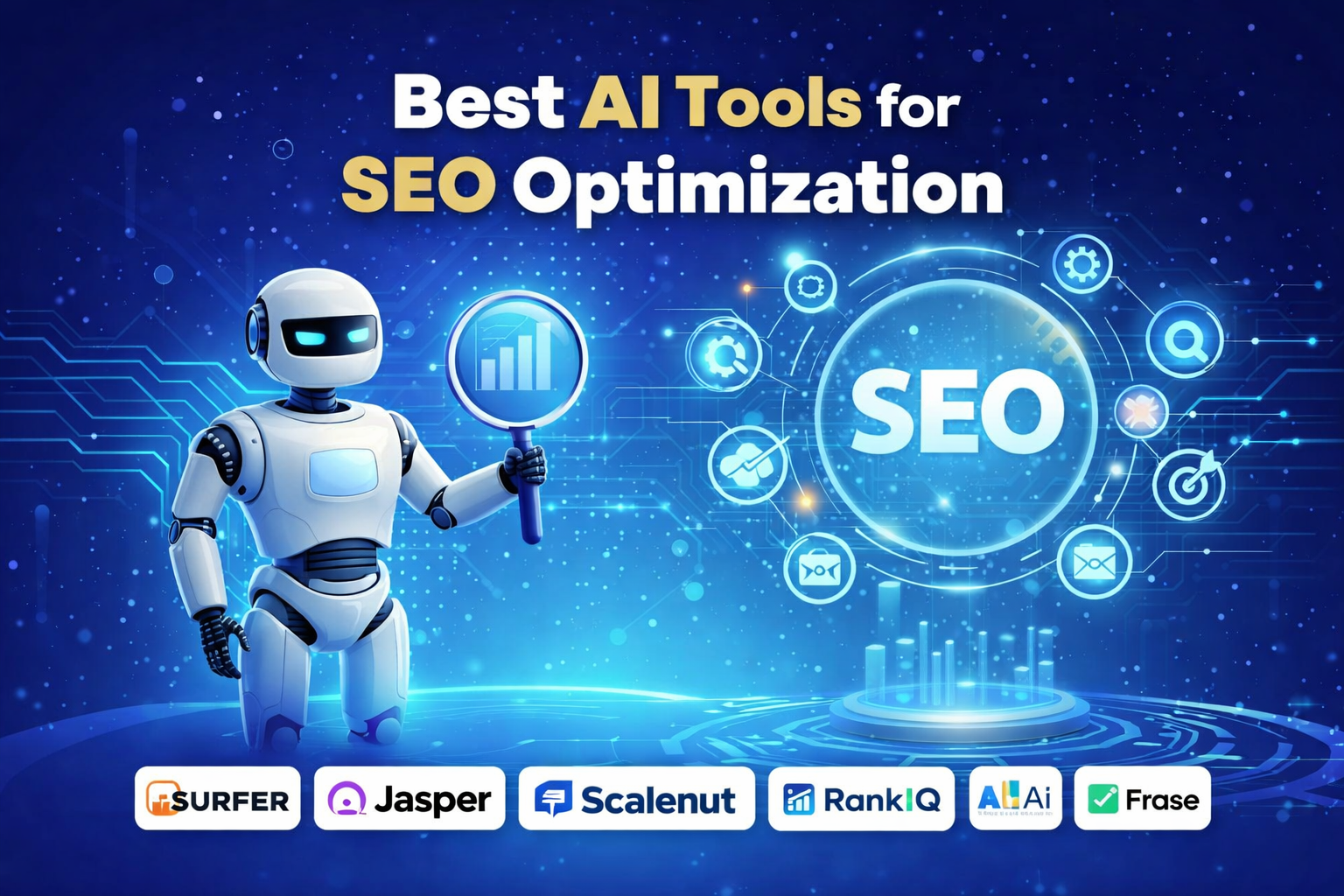
18 Best AI Tools for SEO Optimization (2026 Guide)

Let me be honest with you upfront, Most "best AI SEO tools" lists are written by people who have actually never used the tool. They just copy the features, add a star rating, and call the reviews.
This is not the list you are reading right now.
I have outlined the tools which I have personally used or have heard a lot of good stuff from people I believe - building content briefs, running full audits, going after keyword rankings, and watching what actually moves the needle. Some of these tools are my personal favorites as they save me hours every week. Some of them looked great on paper in demos, but they don't deliver exceptional results. I will tell you which is which.
What you're about to read is my practical observation, not just the causal breakdown of AI tools for SEO optimization in 2026. I will cover each tool that actually does well, and which you should use.
Let us get into it.
What Are AI SEO Tools?
At the most basic level, AI SEO tools refer to platforms that have the power of machine learning and natural language processing to automate, speed up, and improve the accuracy of tasks that used to be done manually in SEO.
Think of things like: which keywords to target, why competitors are outranking you, fixing the technical SEO across multiple pages, tracking which LLm cites your website as a source.
Old SEO tools give you data so that you can manually figure out the things to do with it. AI seo tools take data, run it through machine learning models, and give you recommendations. Instead of looking individually at 200 competitors' URLs, the tools tell you which topics and structural patterns the top-ranking pages share, and what you need to do to compete with them.
AI SEO tools help you with keyword research, content optimization, rank tracking, technical audits, and monitoring brand visibility across AI platforms like ChatGPT, Gemini, and Perplexity.
How AI Is Changing SEO in 2026

Here is an uncomfortable truth you don't need to hear: taking on the first page of Google is not enough. A significant portion of users are no longer clicking on the blue links; they are getting answers through the AI overview or can directly search on ChatGPT.
AI-generated answers are changing the way users seek information, making visibility in AI responses a priority for every business.
This has created a new era called Generative Engine Optimization, or GEO. It is the practice of structuring and writing content in a way that can be cited by large language models when answering questions.
Beyond GEO, a few others also shift how AI is changing SEO right now:
Google's algorithm incredibly rewards topical authority over Individual page optimization. Following the February 2026 Google Discover Core Update, the search algorithm now prioritizes expertise strictly on a "topic-by-topic basis," meaning a highly focused niche site with interconnected customers will easily outrank the broader site that touches the topic superficially.
E-E-A-T (Experience, Expertise, Authoritativeness, Trustworthiness) is more heavily weighted than ever now. AI can generate content with the blink of an eye, but impossible to generate lived experiences. The gap between AI-generated content and human-written content is increasingly visible in rankings.
Despite continuous improvement in AI for content creation, it's just impossible to rank, as SEO ranking content needs a human touch. AI can assist with drafting and research, but human expertise is needed for long-term search visibility.
The tools on this list will help you work faster and better. But they can't replace your judgment. Keep that in mind.
How We Selected These AI SEO Tools
The tools I have mentioned on this list were evaluated on five criteria."
First, does the tool do its magic as it promises? A lot of AI tools promised a lot, but deliver surface-level suggestions in practice. I tested each tool against real projects and real SERPs.
Second, does the data hold up? Cross-check your data in Search Console before trusting its essentials. If keyword volumes are consistently off by more than 15-20%, or the tool suggests optimization that contradicts GSC data, it does not dare to belong to a recommended list.
Third, is it built for real people's work? A great tool fits into your existing data like a glove without the need to rebuild everything. Can you export data easily? Can it be installed with Wordpress, Google Docs, or your CMS?
Fourth, is the price-to-value impressive? Some tools charge for an enterprise price, whereas their alternative is available for $49/month.
Fifth, is the tool related to 2026 SEO, meaning does it account for AI overviews, GEO, and topical authority, not just the traditional keyword ranking?
The 18 Best AI Tools for SEO Optimization
1. Surfer SEO

Best for: Content teams publishing and refreshing pages on a regular cadence.
Surfer SEO is a well-known AI content optimization tool, and for good reasons. The core work of this product is its content editor, what it does, it compares top-ranking pages for your target keyword and gives you a real-time content score as you write. It tells you which term to use, how long the content should be, how many headings it should have, and how you should structure it compared to what is currently winning.
What most people do not mention: Surfer is easy to game. You can add different terms recommended and get a 90/100 score, and still the content feels like it is unreadable and thin. The score is a guide, not a goal.
Its recent updates add premium features, such as brand voice controls, faster Surfer AI, and rank drop detection.
Use Surfer when you want to write new content and need a data-backed starting point for structure and topic coverage. Do not use it as your only quality filter.
Pricing starts at $89/month.
2. Frase
Best for: Solo writers and small teams who need to go from keyword to outline in under 10 minutes.
Frase is a tool I'm gonna recommend if you are spending too much time on research before writing. You just need to put in a keyword, and Frase automatically pulls the top-ranking pages, extracts the headings, key points, and questions people ask related to the topic, and gives you a clean brief to work from.
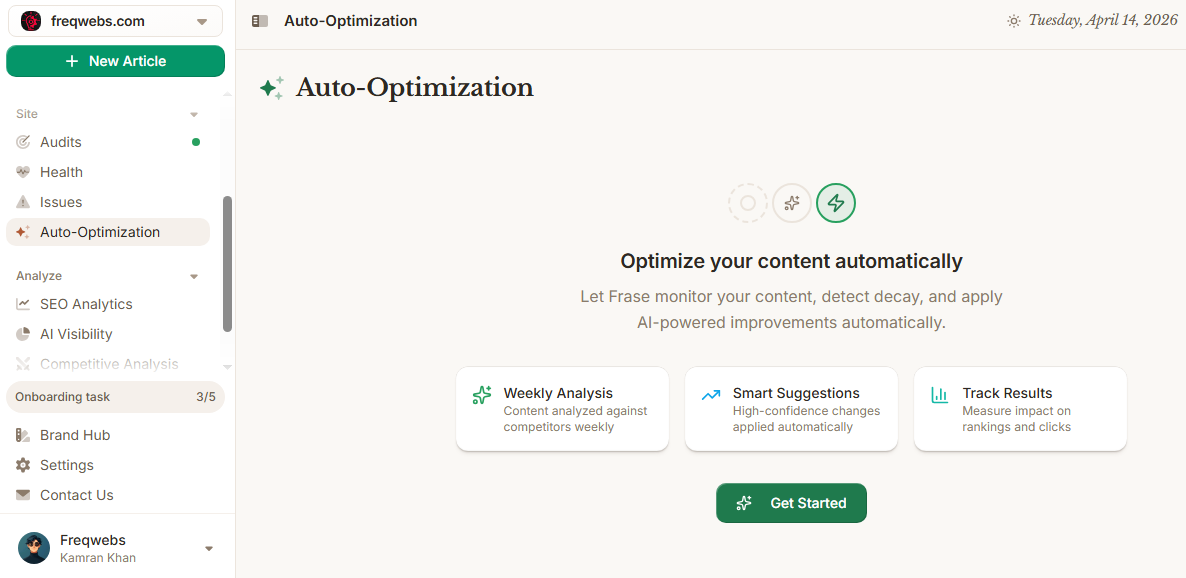
Frase combines research, briefs, editing, and dual SEO+GEO scoring that shows how content aligns with Google and AI platforms like ChatGPT, Gemini, and perplexity.
The contrarian take: Frase AI generates drafts that feel like AI, so you ned to edit it by adding a human touch to it. So I highly recommend you use drafts as scaffolding, not the final copy you need to publish.
Pricing starts around $45/month.
3. Jasper AI
Best for: Content teams that need volume at speed and already have a strong editor on staff.
Jasper is an AI writing platform, not a traditional SEO tool - but it has enough SEO features to be on this list. It integrates with Surfer SEO, which means you write inside Jasper while tracking Surfer content score. It has a branded voice feature that keeps your output consistent with almost every content operation.
If you are managing a content team and want 30 articles a month, Jasper can provide a solid SEO draft on which your content team can work on it and make it more refined and human-friendly. Without the editorial interference, the content feels generic, and generic content is not capable of ranking in 2026.
Use Jasper when you already have a content team, and you need a workflow to work on. Do not use if you plan to create content and publish AI output directly.
Pricing starts around $49/month.
4. Writesonic
Best for: Teams that want content creation, optimization, and AI visibility tracking in one platform.
Writesonic tries to solve the problem of hopping in multiple tools for different purposes into one platform: AI search tracking, SEO research, content writing, content optimization, and site audits. Its AI search tracking covers ChatGPT, Perplexity, Google AI overviews, Gemini, Claude, and Microsoft Copilot.
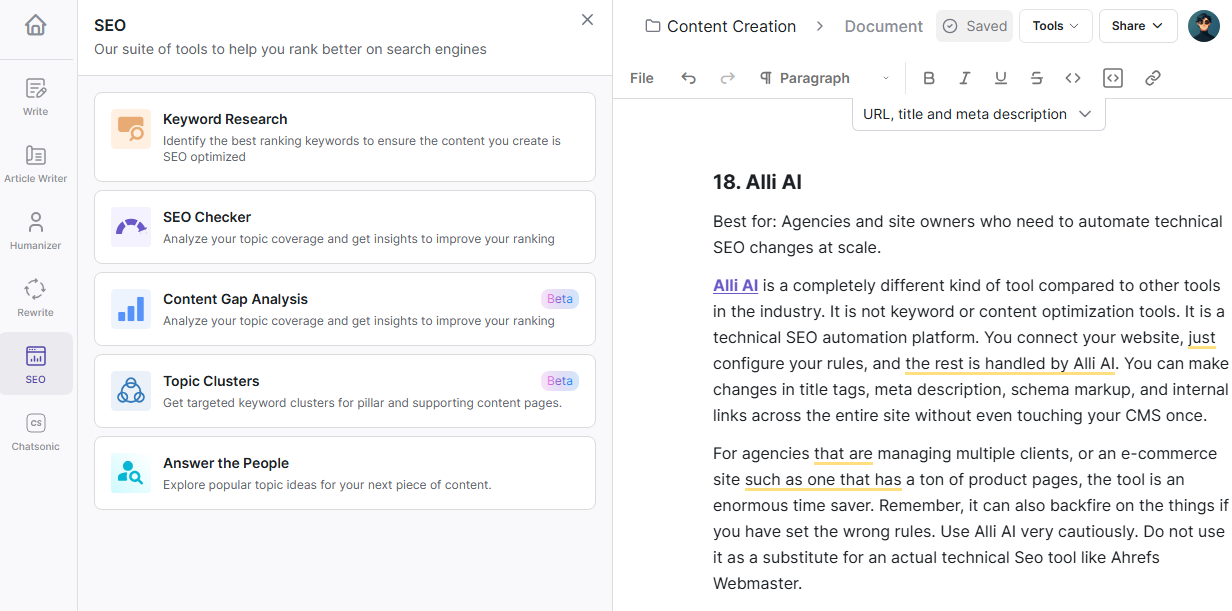
For someone tired of switching five tabs. Writesonic is just for you. The GEO tracking feature alone is enough to justify its price, especially for teams that are not able to afford a dedicated GEO monitoring tool in an existing SEO stack.
Pricing varies by plan, starting around $20/month.
5. Outranking
Best for: SEO operators who want a structured, step-by-step content creation process with AI guardrails.
Outranking is one of the less flashy tools in this list, but best for operators who use a methodical approach when it comes to dealing with SEO. It helps you buy giving a structured process: keyword research, SERP analysis, brief creation, writing, and optimization.
The real strength of the tool is its internal linking and optimization layer. Once you have a bunch of content on your site, outranking helps you to suggest which content needs to link to a new piece - something that most AI writing tools completely ignore.
Pricing starts around $79/month.
6. Scalenut
Best for: Content teams that want keyword planning, brief creation, and writing in one workflow.
Scalenut does not need any introduction in this list. The platform combines keyword clustering, content briefs, AI writing, and NLP optimization. The cruise mode built in Scalenut allows you to adjust a keyword to fully polished written content. I suggest you still edit the output for the best results in SEO.
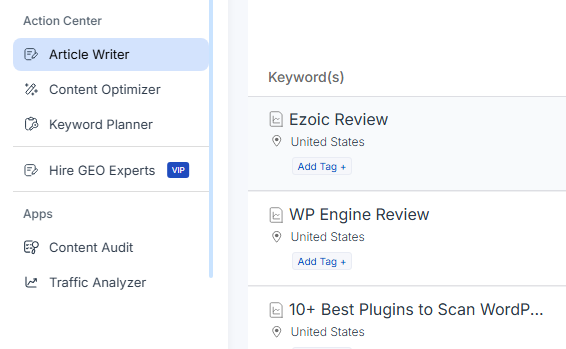
What Scalenut has that the competitors don't is its keyword clustering. Its AI groups related keywords into topic clusters automatically, which helps you build the topical authority without mapping your content calendar.
Pricing starts around $39/month.
7. MarketMuse
Best for: Content strategists at mid-to-large sites who want to build topical authority systematically.
MarketMuse is a tool you use when you are thinking of content strategy at the site level, not at the individual article level. MarketMuse's patented AI inventories your site, models topical authority, and outputs some of the best topic clusters, briefs, and strategy documents.
The insight gave us the overview.... It's not just telling you which keyword to write, but it also showcases gaps in topical coverage compared to competitors and shows how those gaps affect your authority.
The cons of MakretMuse are its cost. MarketMuse is priced for teams with a budget; its plans start around $149/month, and the free plan is very limited. Marketmuse is not for small teams and small businesses. If you are managing content for established sites with competitive pressure, it's one of the best tools in this entire list.
8. Clearscope
Best for: Professional content teams that prioritize quality and want an editor-friendly interface.
Clearscope has earned its reputation as one of the most reliable content optimization tools in the market. It analyzes the search engine results page for your target keyword and provides a content score, which is based on keyword density, word count, and topical relevance. Its keyword suggestions, readability tops, and competitor analyses give us an instant edge, which helps us refine blog posts and webpages for better visibility. The clean interface is a boon for writers and integration with Google Docs and Wordpress make its easy to fit into any workflow.
Clearscoe has always been in demand by enterprises due to its "Topical map" approach and cleaner interface.
If you are a writer who doesn't know much about SEO, Clearscope is your go-to tool.
Pricing starts at around $170/month, worth it for enterprise teams.
9. SEMrush
Best for: Agencies and in-house teams that want an all-in-one SEO command center with growing AI features.
Semrush is the gold standard for digital marketers and businesses around the world. What makes Semrush stand out is its AI visibility toolkit, which tracks more than 100 million prompts across ChatGPT, Google AI mode, Perplexity, and AI overviews in six regions. No other tool in the market is capable of this level of AI search monitoring at scale.
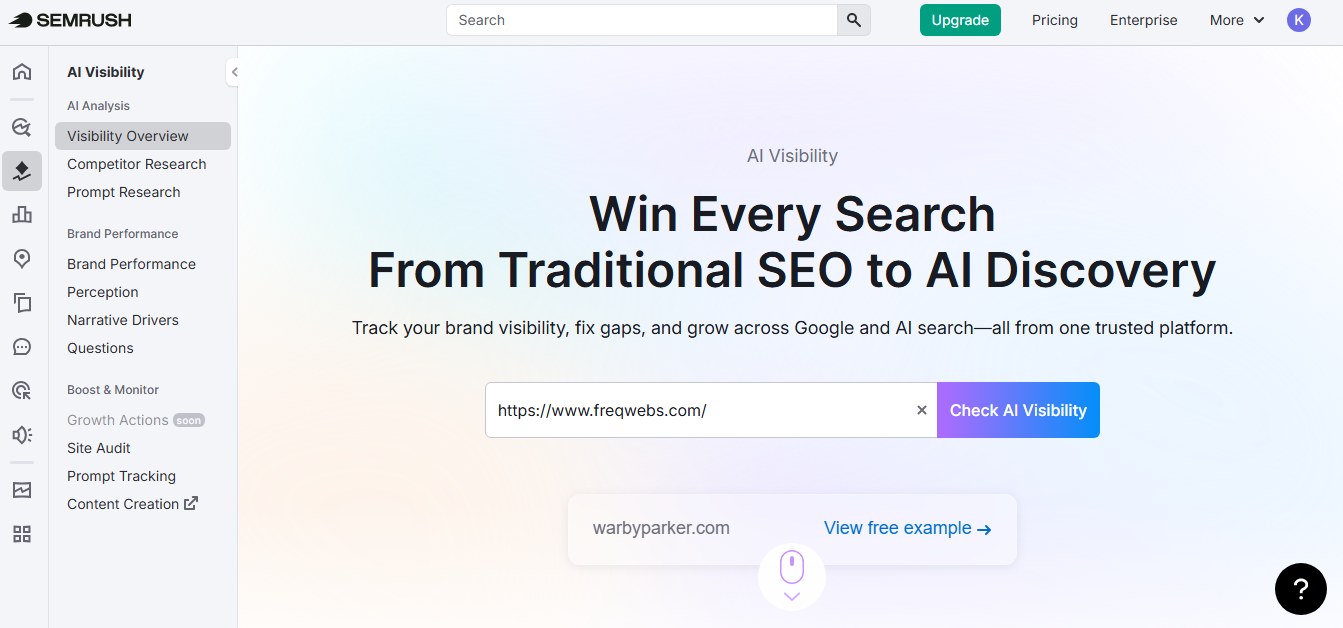
Semrush AI also analyzes competitors and is capable of predicting the next move. It includes a writing assistant as well, that's suggets topic on real-time competitive gaps and groups thousands of keywords into intent-based clusters that, too, in auto mode.
Semrush is not cheap, its plans start around $139.95/month - and yes, it could be overkill for solo creators and bloggers. But for the agencies managing multiple clients or for in-house teams for serious companies, it is arguably the deal-breaker tool out of all the tools I mentioned in this list.
10. Ahrefs
Best for: Data-driven SEO professionals who want the most reliable backlink index and keyword data.
In 2026, Ahrefs still tops the ranking if we are talking about SEO tools in the market. Ahrefs is the best choice for data pursuits that want the most reliable link index. The platform also has an enormous keyword database; its backlink data is what you can rely on, and the site audit tool, which you can get access to through Ahrefs Webmaster tools, is truly a game-changer; it helps you to fix all kinds of technical issues that other tools miss.
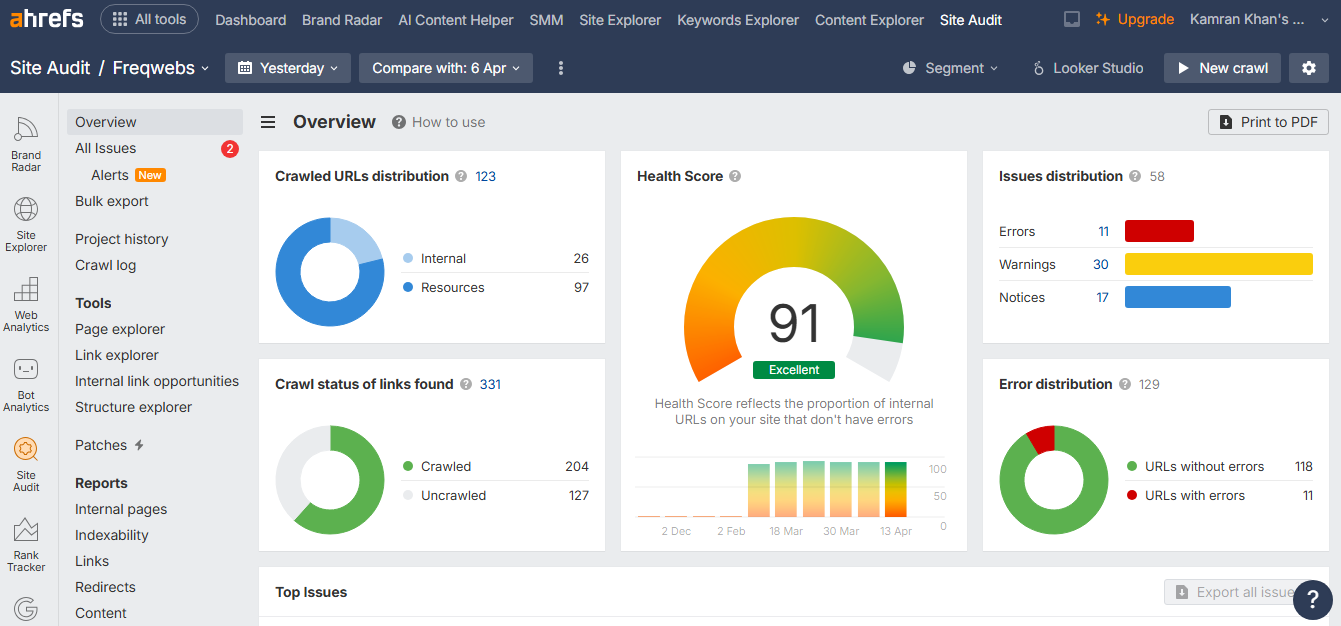
Ahrefs also introduced Brand Radar, which tracks brand mentions across 260 million monthly prompts covering ChatGPT, Perplexity, and Google AI overviews.
The honest take - Ahrefs is a tool that SEO professionals can rely on. It gives you data that you can trust. What they are doing in the SEO domain is irreplaceable.
Pricing starts around $129/month.
11. NeuronWriter

Best for: Budget-conscious operators who want Surfer-level content optimization without Surfer prices.
NeuronWriter is the best-kept secret in this list. It used NLP-based content scoring, competitor analysis, and semantic term recommendations to help you optimize content in the best possible way, and it does that at an affordable price compared to Clearscope and Surfer SEO.
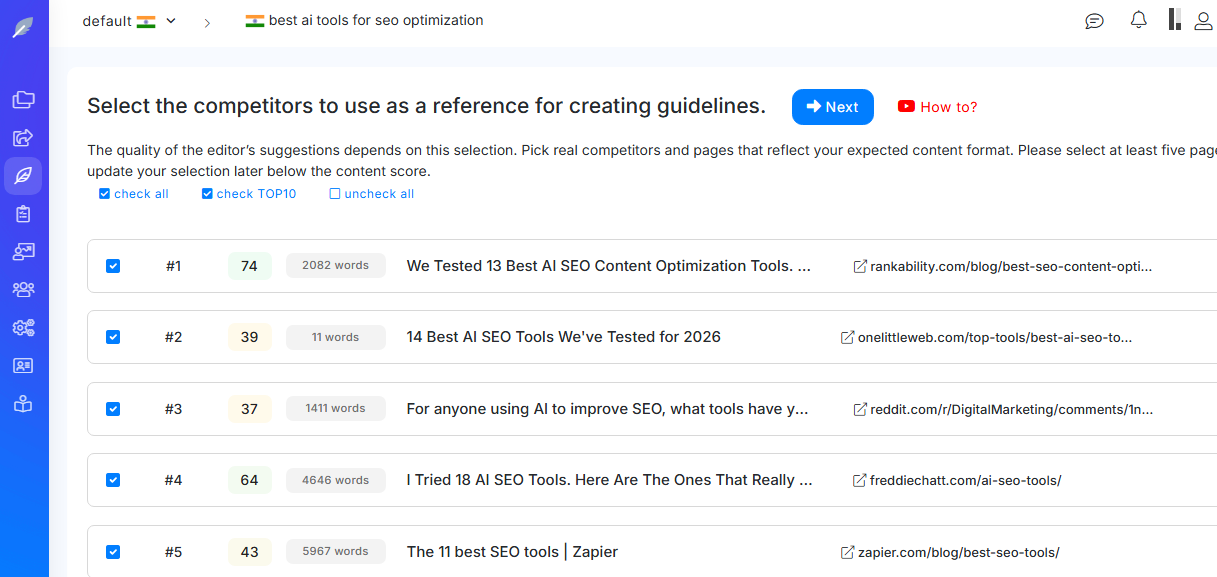
It gives similar features to Surfer at a much lower price point.
The interface is not as polished as other platforms, and AI writing is not the standard of Jasper or WriteSonic. But if you have a small team and want reliable content optimization, Neuron Writer is the way to go. Lifetime deals are also listed on Appsumo, which makes it even more attractive.
Pricing starts around $23/month.
12. INK Editor

Best for: Writers who want an AI assistant that keeps content optimized in real time while they write.
INK Editor combines AI writing assistance capabilities with SEO optimization in a single writing interface. As you started writing, you started to see scores right away for your content, and it gives you suggestions for improving both readability and SEO relevance. Think of it as a lighter version of SEO with a stronger AI writing component.
Where INK differentiates itself is its focus on AI content protection - the main objective is that content created with AI is less likely to be flagged as AI-generated. Whether the claim holds its ground in the future, I don't know, but it's still debatable. But the real-time optimization layer is really very useful for a writer who wants guidance without switching multiple tools.
Pricing starts around $39/month.
13. RankIQ
Best for: Bloggers and niche site operators who want to find low-competition keywords quickly.
RankIQ is built specifically for bloggers, and that shows in their work. The core value of the tool is to provide low competition, high traffic keywords across blogging niches. Instead of you selecting the right keyword, RankIQ tells you the right keyword that has the best shot when it comes to ranking fast.
It also has a content optimization tool that tells you what to include in your article if you are targeting a particular keyword. It is way simpler than Surfer and clearscope. If you are a food or personal finance blogger, it gives you actionable keyword insights without a steep learning curve.
Pricing starts around $49/month.
14. SEO.ai
Best for: Content teams that want enterprise-grade AI writing with built-in SEO intelligence.
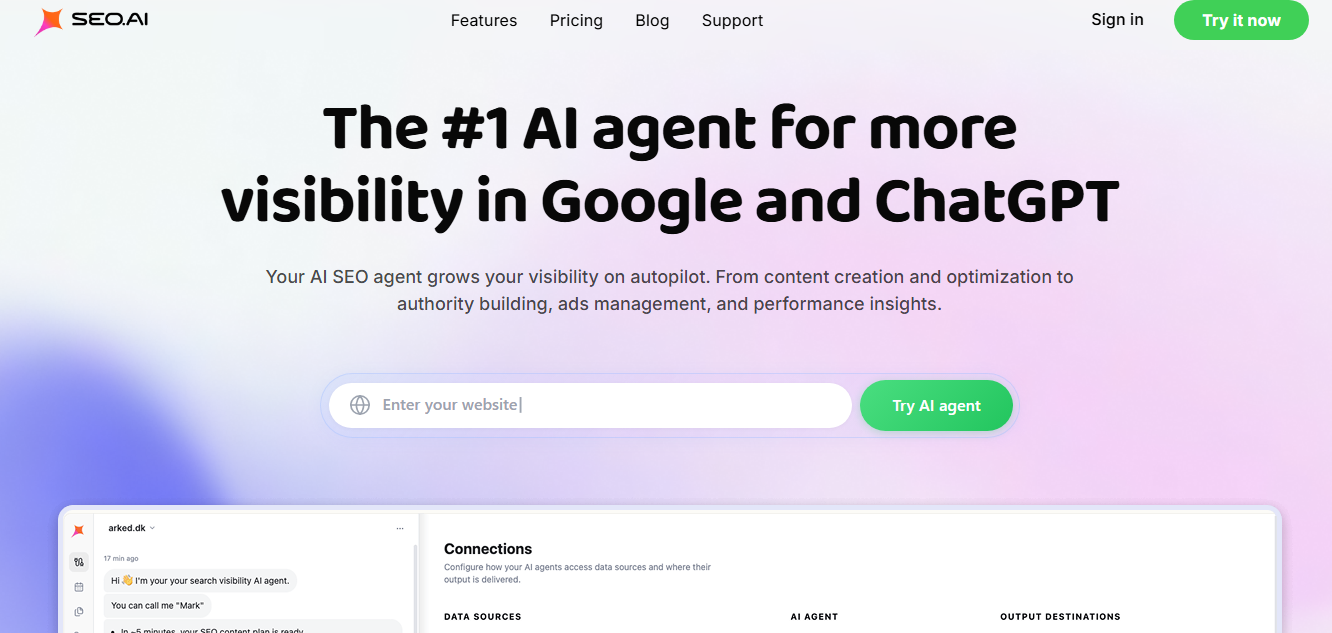
SEO.ai is a new entrant in the market, but it has gained attention quickly. It combines a top-notch AI writing engine with deep SEO data, allowing you to do things like research, write, and optimize with ease in a single platform. The interface is pretty straightforward, and the output quality is above average if you analyze the AI-generated content.
For teams who are fed up with the pricing of Jasper, SEO.ai is worth checking out.
Pricing starts around $49/month.
15. GrowthBar
Best for: Small businesses and content teams that want a simple AI SEO tool without a steep learning curve.
GrowthBar is another tool that already has a standard in the industry. It combines keyword research. competitor analysis, content generation, and optimization scoring, all within a single dashboard. Even if you're not an SEO expert, this tool helps you to get value out of it. An AI blog writer can generate a full long-form article in the blink of an eye.
However, Growtbar does not go as deep as Ahrefs for backlink data or as deep as Clearscope for content optimization. But for a small business, it still can do wonders. It takes out the task of learning SEO tools and fills all the gaps needed.
Pricing starts around $48/month.
16. CanIRank
Best for: Solo operators and small businesses that want AI-driven, personalized ranking recommendations.
Most SEO tools in the market give you data; CanIRank gives you a list of what to do next. It analyzes the strengths and weaknesses and gives you a probability score of ranking for each keyword.
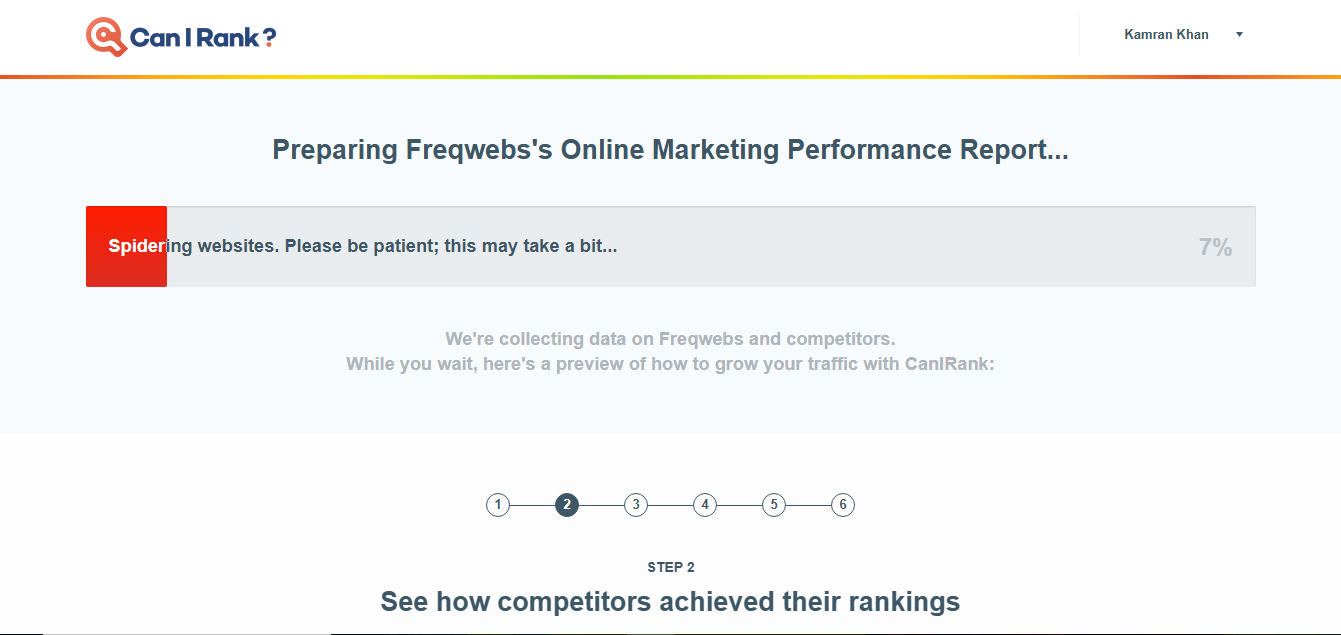
This works really well for smaller sites. Knowing just the keyword difficulty doesn't give a perfect picture, and in that case, CanIRank does its work well; it tells you where you are ranking today and your realistic shot at this keyword.
Pricing starts around $49/month.
17. Diib
Best for: Small business owners who want automated SEO monitoring without hiring an SEO consultant.
Diib connects your search console to Google Analytics, analyzes all your data, and gives you recommended actions right away. It benchmarks your performance with competitors and sends alerts when something changes.
It's not the most powerful tool. But for small businesses that don't have the time to become an SEO expert, Diib delivers exceptional, actionable insights per minute that almost no tool in our list can do.
Pricing starts around $14.99/month, with a free plan available.
18. Alli AI
Best for: Agencies and site owners who need to automate technical SEO changes at scale.
Alli AI is a completely different kind of tool compared to other tools in the industry. It is not keyword or content optimization tools. It is a technical SEO automation platform. You connect your website, just configure your rules, and the rest is handled by Alli AI. You can make changes in title tags, meta description, schema markup, and internal links across the entire site without even touching your CMS once.
For agencies that are managing multiple clients, or an e-commerce site such as one that has a ton of product pages, the tool is an enormous time saver. Remember, it can also backfire on the things if you have set the wrong rules. Use Alli AI very cautiously. Do not use it as a substitute for an actual technical Seo tool like Ahrefs Webmaster.
Pricing starts around $299/month for agency plans.
Best AI Tools for SEO Optimization by Use Case
Not every tool is best for every scenario, here is the decision guide for you:-
| Use Case | Best Tool |
|---|---|
| Content optimization (on-page) | Surfer SEO or Clearscope |
| Keyword research and backlinks | Ahrefs or SEMrush |
| AI Overviews and GEO tracking | SEMrush AI Toolkit or Writesonic |
| Building topical authority | MarketMuse or Scalenut |
| Content briefs and outlines | Frase |
| AI writing at volume | Jasper AI or Writesonic |
| Budget content optimization | NeuronWriter |
| Blogger keyword research | RankIQ |
| Technical SEO at scale | Alli AI |
| Small business automation | Diib or GrowthBar |
| Personalized ranking advice | CanIRank |
Free vs Paid AI SEO Tools
Here is an honest takedown: free AI SEO tools are useful for validation and light tasks. They are not the best to rely on for competitive SEO in 2026.
Google Search Console remains the best free SEO tool. It shows you the exact queries you are getting impressions and clicks, which pages are underperforming, and which pages are close to being at the top rankings. Every paid toll on this list was validated against GSC data.
Google Keyword Planner is free and gives you search volume data, but the data is granular compared to tools like Ahrefs and Semrush.
ChatGPT is a great tool for keyword clustering, generating content, and writing schema markups. However, it lacks a real-time keyword database - you can't ask for keyword search volume or rankings because it does not crawl the web like the tools Semrush and Ahrefs.
How to Use Best AI Tools for SEO Optimization (Step-by-Step Workflow)
This is the section most guides just skip. owning the tool is not the same as having a process.
Here is the workflow you ned to align with:
Step 1: Keyword research - Start your process with Ahrefs or Semrush, identify the target keyword based on search volume, keyword difficulty related to your domain authority, and search intent alignment with your content goals. Export your list.
Step 2: Topical gap analysis - use MarketMuse or Scalenut to identify which topic you are covering and which doesn't compare to the competitors. This tells which content to prioritize rather than just going after individual keyword volume.
Step 3: Build the brief - Use Frase and Surfer SEO to build the content brief. Pull out the competitors' headings and common questions. This takes 15 minutes of your time compared to 2 hours of manual search.
Step 4: Write the Draft - Use Jasper, Writesonic, or SEO.ai for the first draft. If you have a content writer, give them the brief and tell them to work on. The AI draft works only if you have a human writer. It falls if you just copy and paste and publish it on the site.
Step 5: Optimize - Run your draft to ClearScope, Surfer, or Neuronwriter. You instantly get the score (do not obsess over 100%) and make sure the entity coverage will be covered.
Step 6: Publish and Internal link - Use your CMS and connect new content to the existing article. To automate this, you can use Outranking and Alli AI.
Step 7: Monitor - Track ranking in Semrush or Ahrefs. Track AI visibility with the Semrush AI toolkit. Also, check the search console weekly for performance signals.
Step 8: Refresh. Content decays. Set a calendar reminder that alerts you about your article that ranks in position 5-15 every 6 months. Update articles, add new ideas into it, and re-optimize with content scoring tools.
Common Mistakes to Avoid
The biggest mistake to avoid is publishing AI-generated content directly on the site without editing it. Google's spam policies are intelligent enough to determine low-quality AI content.
Chasing the content score instead of the reader. Surfer and clearscope scores are just indicators, not guarantees. An article with a score of 68 that looks insightful and has no grammatical mistakes can still outrank the content score of 92 that reads like a sentence assembled by an algorithmic robot.
Buying tools without having publishing workflows. If you are not frequently publishing, using AI SEO tools will not work...the tool works on your existing processes. They do not create them.
Ignoring GEO. If your articles are not cited by AI overview and LLM answers, you could be left behind in the long run. Add a GEO tracking to understand how your content is represented in AI responses.
Using too many tools also breaks the rhythm. Running five AI seo tools in parallel creates lots of confusion, not results. Pick one tool for a particular function that includes writing, optimization, and tracking.
Final Verdict
If you could only pick 3 tools for an AI SEO workflow, here is where I can put my valuable money in:
Ahrefs or Semrush for research, competitive intelligence, and AI visibility tracking. Semrush is best for AI features and content tools; Ahrefs wins on data purity and backlink intelligence.
Surfer SEO or Clearscope for content optimization. Surfer is best for teams when working on a volume of content. Clearscope is better for team who prioritize quality and want a less distracting interface.
Frase for research and brief generation. At its price point, it's the best tool in its category.
Everything else on this list is a specialized tool. You add tools if you have specific needs for them.
Bonus SEO Tips
Keep your content updated; Google loves freshness. Have an audit of your content every quarter at least for your high traffic pages. A 20-minute update can recover ranking way faster if done correctly.
Topical authority is what you need to align with. It's better to niche down your content, have multiple content in one particular niche, so that they are interconnected.
Use schema markup. FAQ schema, HowTo schema, and Article schema, which can help to appear in AI overviews and featured snippets. Tools like Alli AI and Semrush can automate schema implementation at scale.
Pro Insight
Here is something most AI SEO tool reviews will never tell you: the tools that are ground-breaking in SEO in 2026 are not the ones with the most features. They are one who natively builds for the GEO and AEO layer - helping you track the AI visibility in ChatGPT, Perplexity, Google AI mode, and other tools.
The site that's winning in 2026 is simultaneously optimizing for traditional search and AI-generated answers. Start tracking your AI visibility now; it's the demand of the industry.
FAQs
What is the best AI tool for SEO in 2026?
There is no single best tool for every kind of task. For all-in-one capabilities, SEMrush leads the chart for sure. For content optimization, I recommend going with Surfer SEO and Clearscope. For people who want a budget-friendly option, opt for NeuronWriter and Frase.
Can AI tools replace SEO experts?
No. AI tools can't replace SEO experts, but they can automate data analysis, speed up content creation, and surface optimization recommendations. But for strategic decisions, understanding your audience and creating content that builds long-term authority will surely stand out.
Are free AI SEO tools worth using?
Yes, for specific tasks. Google Search Console is irreplaceable and completely free. ChatGPT is also very good when it comes to keyword clustering and content outlines. But for competitive SEO, paid tools give you an edge for sure.
How much should I spend on AI SEO tools?
If you are a solo operator or small team, a budget of $100-200/month can cover full-stack SEO: one research tool (Ahrefs or SEMrush at a starter tier), one content optimization tool (Surfer or NeuronWriter), and one brief/research tool (Frase).
What is GEO and why does it matter?
GEO stands for Generative Engine Optimization. It is the practice of optimizing your content in a way that it can appear or be cited by AI-generated answers on platforms like ChatGPT, Perplexity, and Google AI Overviews.
Do AI SEO tools work for small businesses?
Yes, with the right tools, it can work for small businesses. Tools like Diib, GrowthBar, RankIQ, and CanIRank are specifically designed for smaller sites without dedicated SEO teams.
➤ Disclosure: Our content is reader-supported. If you click on certain links, we may make a commission. [Learn More]