Semrush vs Mangools: Which SEO Tool Is Best For You?

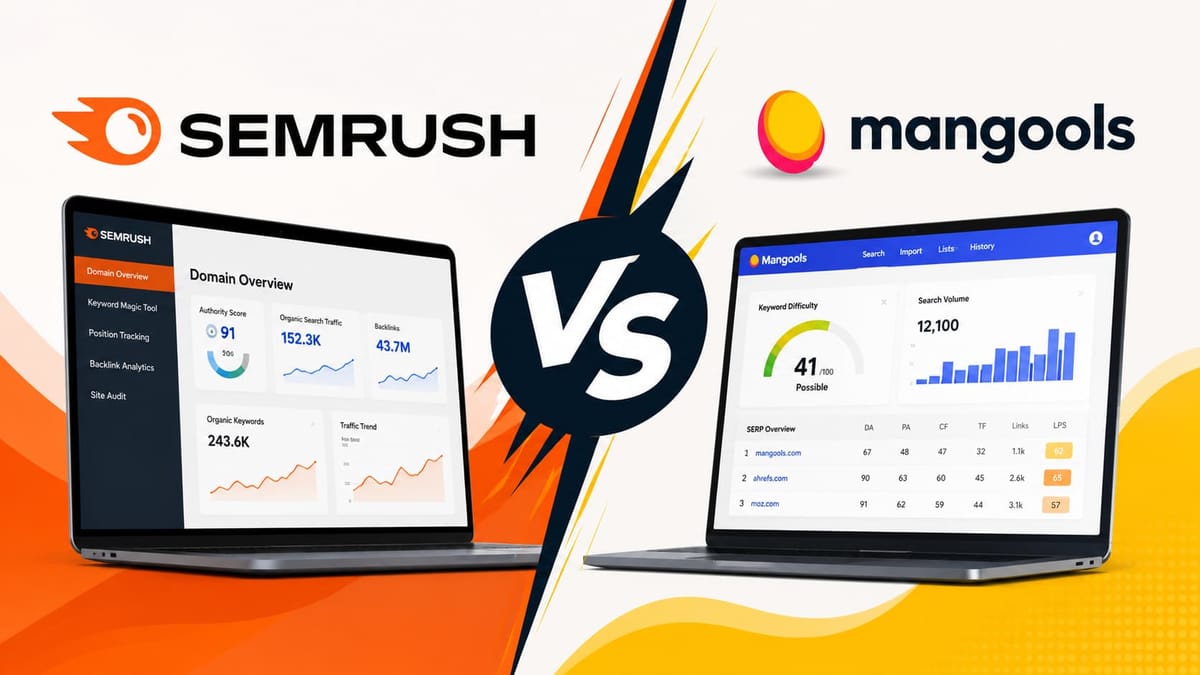
If you have ever been searching for the right SEO tools, two names surely come up over and over again: Semrush vs Mangools.
Both promise to help you out with finding keywords, tracking rankings, and beating the competitor. But they are built for different kinds of users, and picking the wrong ones means overpaying for features that you are never going to touch or that are not helpful for you.
This super guide helps you compare SEMrush vs Mangools feature by feature, based on real usage, and not just the hype created by marketing channels. By the end of this post, you will find out exactly what your budget, skill level, and goals are. Let's start the showdown.
Quick Comparison Table: Semrush vs Mangools
Before we get into the details, let's see a snapshot of what these tools do.
| Feature | Semrush | Mangools |
|---|---|---|
| Best For | Agencies, established businesses, in-depth marketers | Beginners, bloggers, solo creators, small businesses |
| Starting Price (annual) | $117.33/month | $29.90/month |
| Free Plan | Very limited free tier | Free plan plus 10-day trial with elevated limits |
| Ease of Use | Moderate learning curve | Very beginner-friendly |
| Keyword Database Size | Massive | Solid but smaller |
| Site Audit Tool | Yes, very detailed | No dedicated site audit tool |
| Backlink Database | Very large | Smaller, good for quick checks |
| Overall Verdict | Best all-in-one suite for serious SEO work | Best value tool for beginners on a budget |
What is Semrush?

Semrush is one of the biggest names in the digital industry, recently acquired by Adobe. It started as just a keyword research tool, now grown to a full marketing suite that covers SEO, content marketing, PPC, social media, and competitor research.
Think of Semrush as a Swiss Army knife. If you are managing multiple sites, running an agency, or need competitive intelligence, SEMrush is your go-to tool for it.
Beginners are always the most demanding people of Semrush, as they are just starting out and need some extra edge. Instead of just thinking about what competitors are doing great, Semrush shows you their traffic, their best-performing pages, and exact keywords, sending them visitors all year long.
What is Mangools?
Mangools is a lightweight SEO tool that is very demanding among beginners. It comprises five tools: KWFinder for keyword research, SERPWatcher for rank tracking, SERPChecker for SERP analysis, LinkMiner for backlinks, and SiteProfiler for quick site overviews.
If you are starting a blog or running a small business, Mnagools is the tool specifically built for you. The interface is very clean, the reports are just spectacular, and you don't need to pay for features you don't want to open in a lifetime.
Beginners needed a tool like this because SEO needs a learning curve. What Mangools does best is strip down the unnecessary things and just focus on what is needed: finding keywords you can rank for and tracking the progress.
Feature-by-Feature Comparison: Semrush vs Mangools
Now gets into a bit of detail. We will go tool by tool and compare the two giants, Semrush and Mangools, on almost every SEO core job. I have been a user of both, currently using the Pro plan of Semrush for all SEO activities.
Keyword Research
Keyword research is the foundation of SEO, and both tools handle it very efficiently.
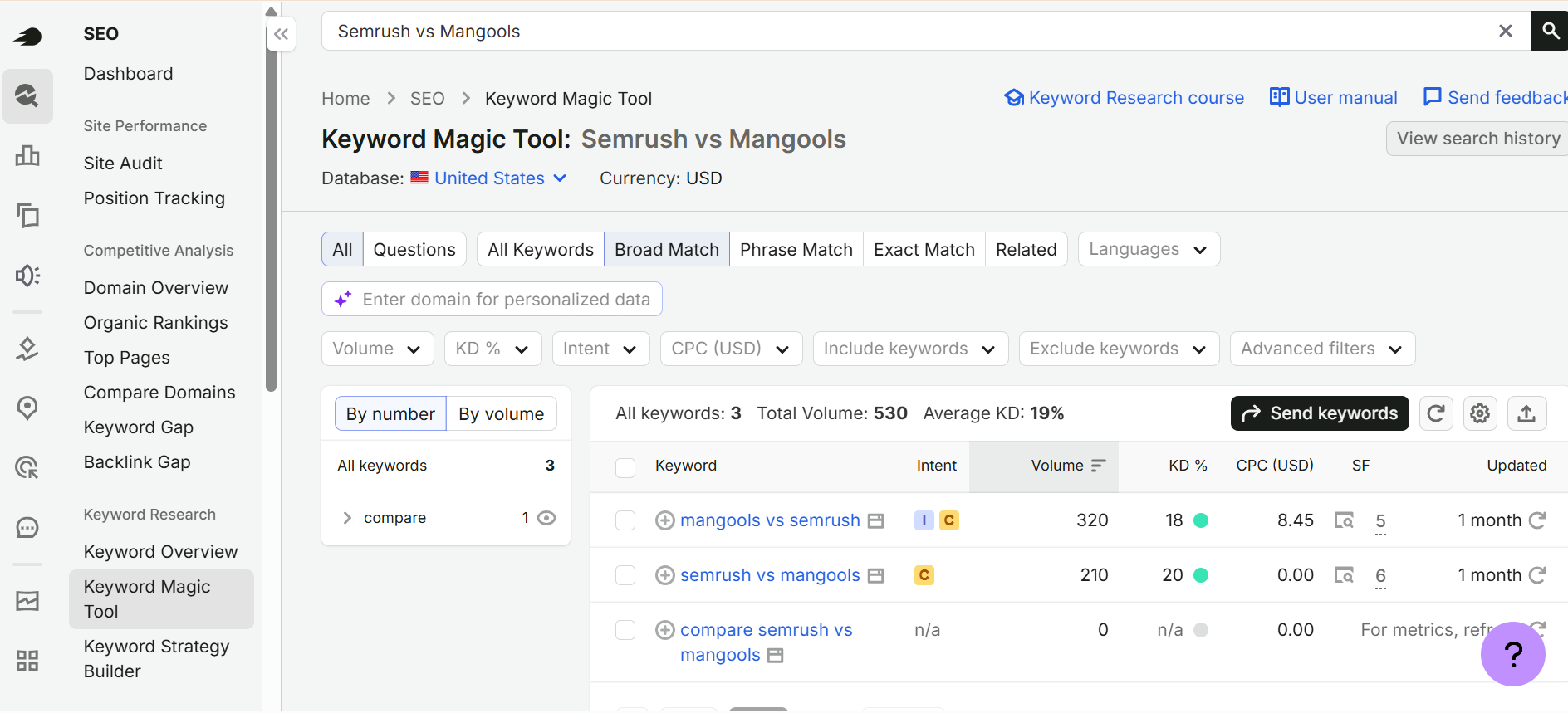
Semrush Keyword Magic Tool pulls the data from a database of billions of keywords across more than 140 countries. You will get the data of search volume, keyword difficulty, search intent, related questions, and SERP features in one single view. How cool is that?
Mongool KWFinder, on the other hand, focuses more on finding low competition and long-tail keywords that could be realistically ranked. The interface gives you search volume, keyword difficulty, and a list of related keywords, which makes your life easy.
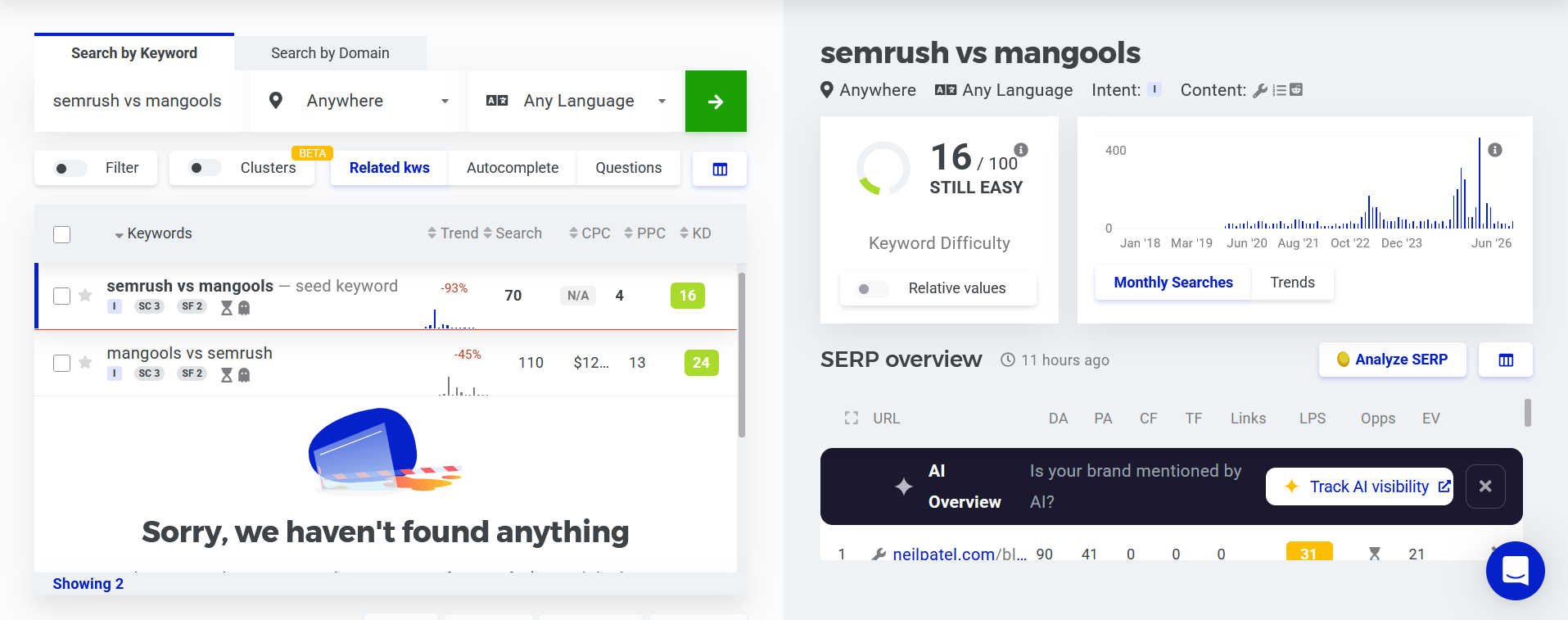
If you are just starting out, KWFinder appears to be a cheap and easier option for you.
If you are running a business, Semrush's larger database and filtering options just give you the best edge to rank on search engines.
| Aspect | Semrush | Mangools |
|---|---|---|
| Database Size | Billions of keywords, 140+ countries | Smaller but reliable for common markets |
| Search Intent Data | Yes, detailed | Basic |
| Beginner Friendliness | Moderate | Excellent |
Verdict: Mangools wins on simplicity; Semrush wins on depth and scale.
Competitor Research
This is where Semrush comes into play. Its domain overview and traffic analytics tools let you see competitors estimated traffic, their top pages, keywords, and even data on where backlinks are coming from. I have searched for one of the competitors, and here are the data as follows:
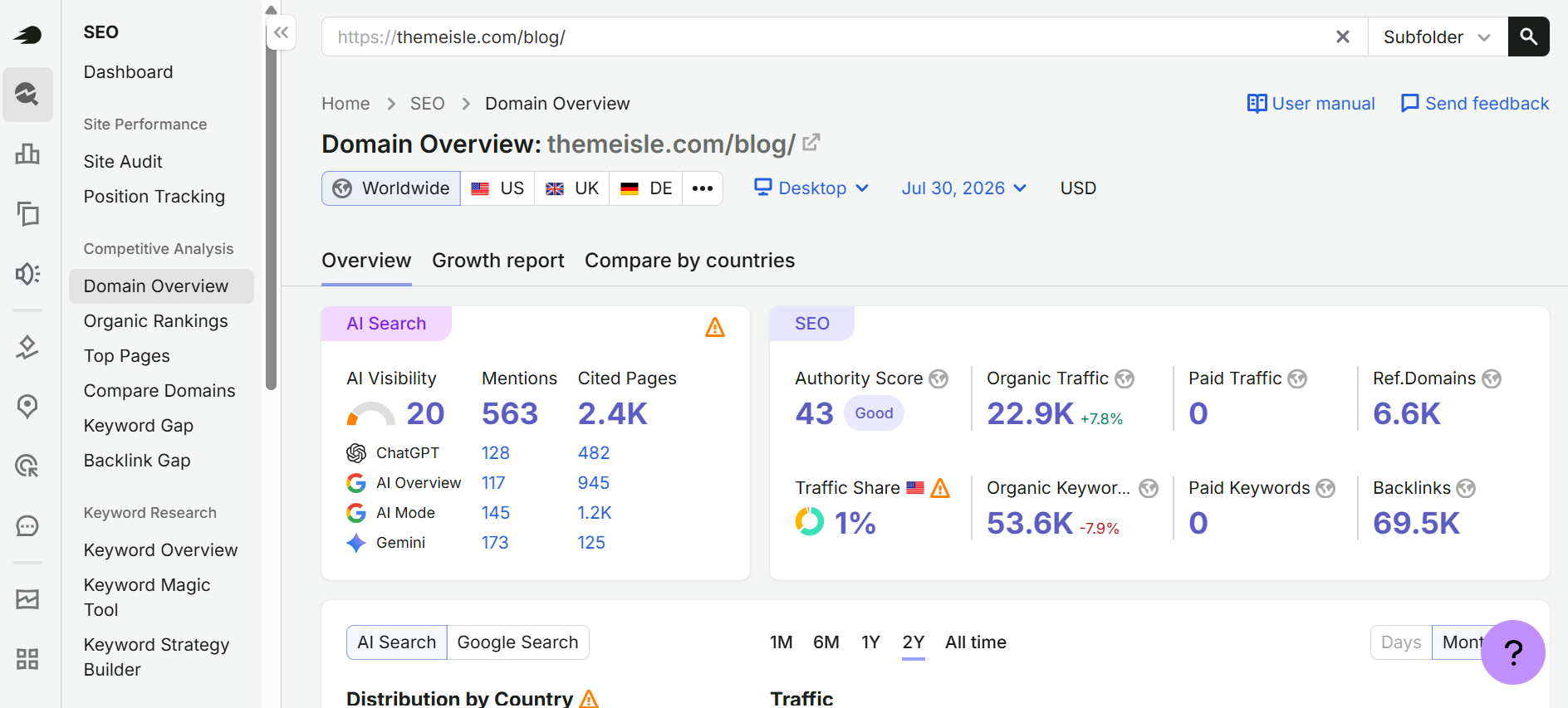
If you are a small business and want to know why competitors are outranking you, Semrush is a worthy choice to go for.
Mangools, on the other hand, doesn't have a dedicated competitor research suite. SiteProfiler just gives you an overview of the domain, keywords, and backlinks, but it's just a snapshot from where you can get the useful data, which helps you to outsmart competitors.
Verdict: Semrush is significantly better here, and this is one of the main reasons why agencies go gaga over Semrush over Mangools.
Backlink Analysis
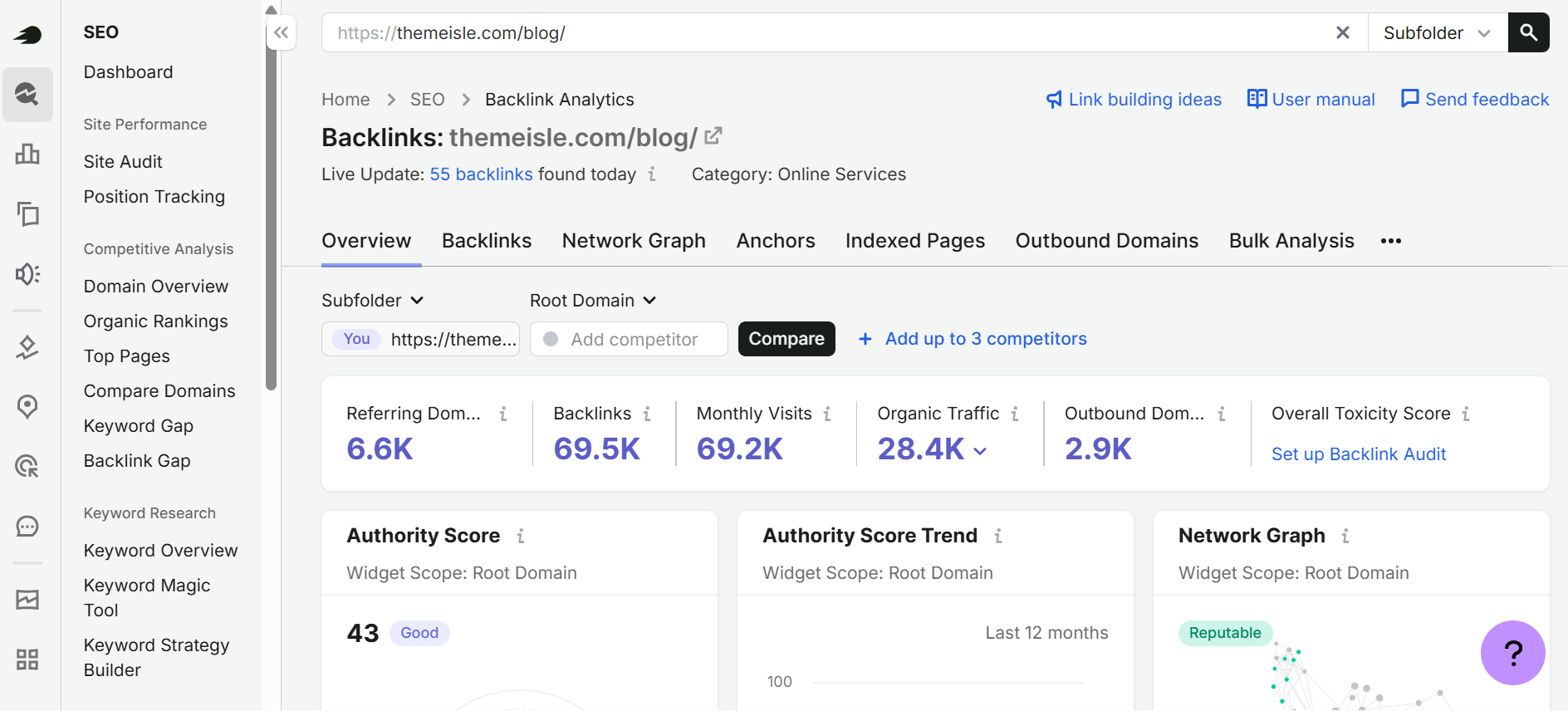
Semrush's Backlink Analytics tools are built on some of the largest backlink databases. You will get an overview of referring domains, anchor text, and toxic link warnings and compare your backlink profile against your biggest competitors, and that too in side-by-side versions.
Mangools' LinkMiner covers the basics well, and i think it almost does the job well. You can check any domain's backlinks, do filtering kinds of stuff like follow or nofollow, and see anchor text as well. Personally, I find it very useful; I can check it before reaching out for guest posts or partnerships, but the database feels a bit smaller compared to giants like Semrush.
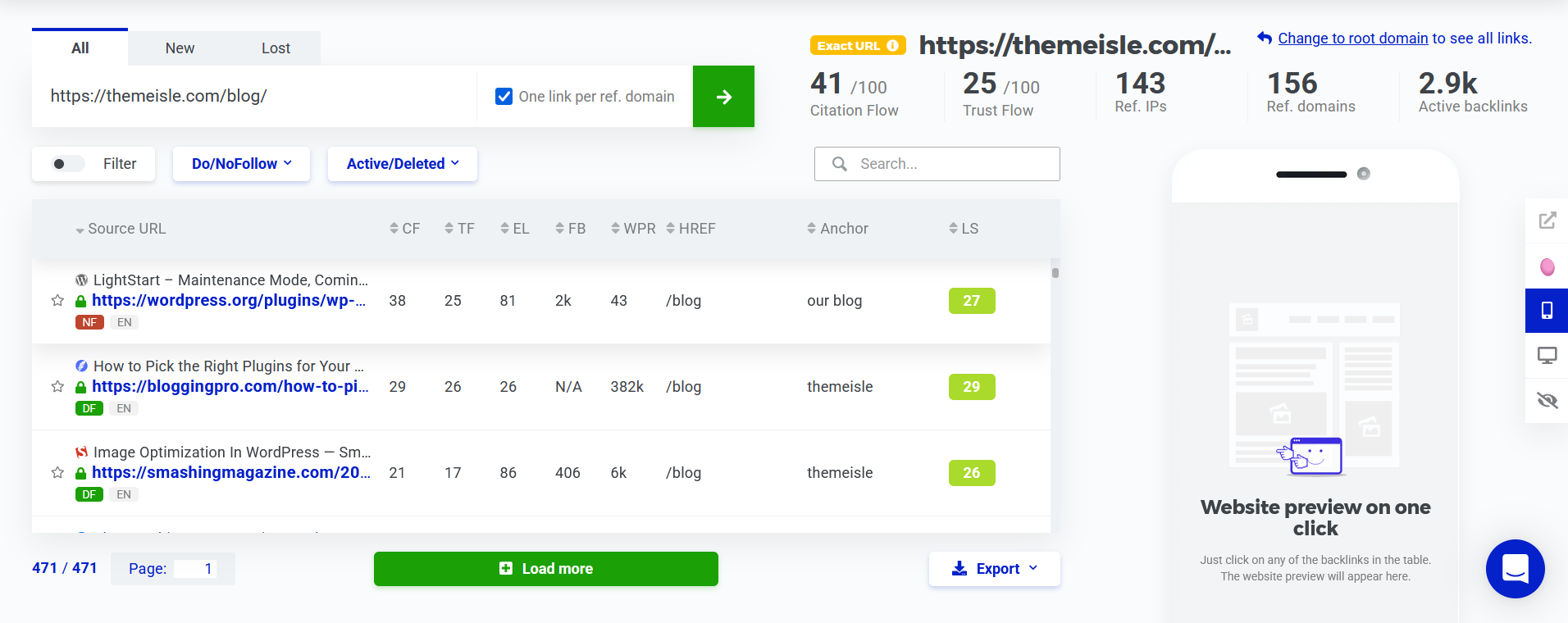
If you are doing some serious link building for clients and your own work, I again recommend you lean towards SEMrush.
Verdict: Semrush for depth, Mangools for a quick overview.
Rank Tracking
Sermursh Position Tracking tools are here to stay and give you the power to monitor rankings across desktop and mobile.
Mangoools SERPWatcher, on the other hand, tracks your rankings with the best visual dashboard. It's less granular than Semrush but far easier to have a glance and understand things for beginners when starting out.
Verdict: Mangools makes tracking way more enjoyable for beginners. Semrush is more suitable for larger sites and multiple locations.
Site Audit
This is one of the biggest differentiators. SEMrush Site Audit is a very comprehensive tool: it audits and crawls your full site, flagging technical SEO issues: broken links, duplicate content, missing meta tags, slow-loading pages, crawlability problems, and a lot more.
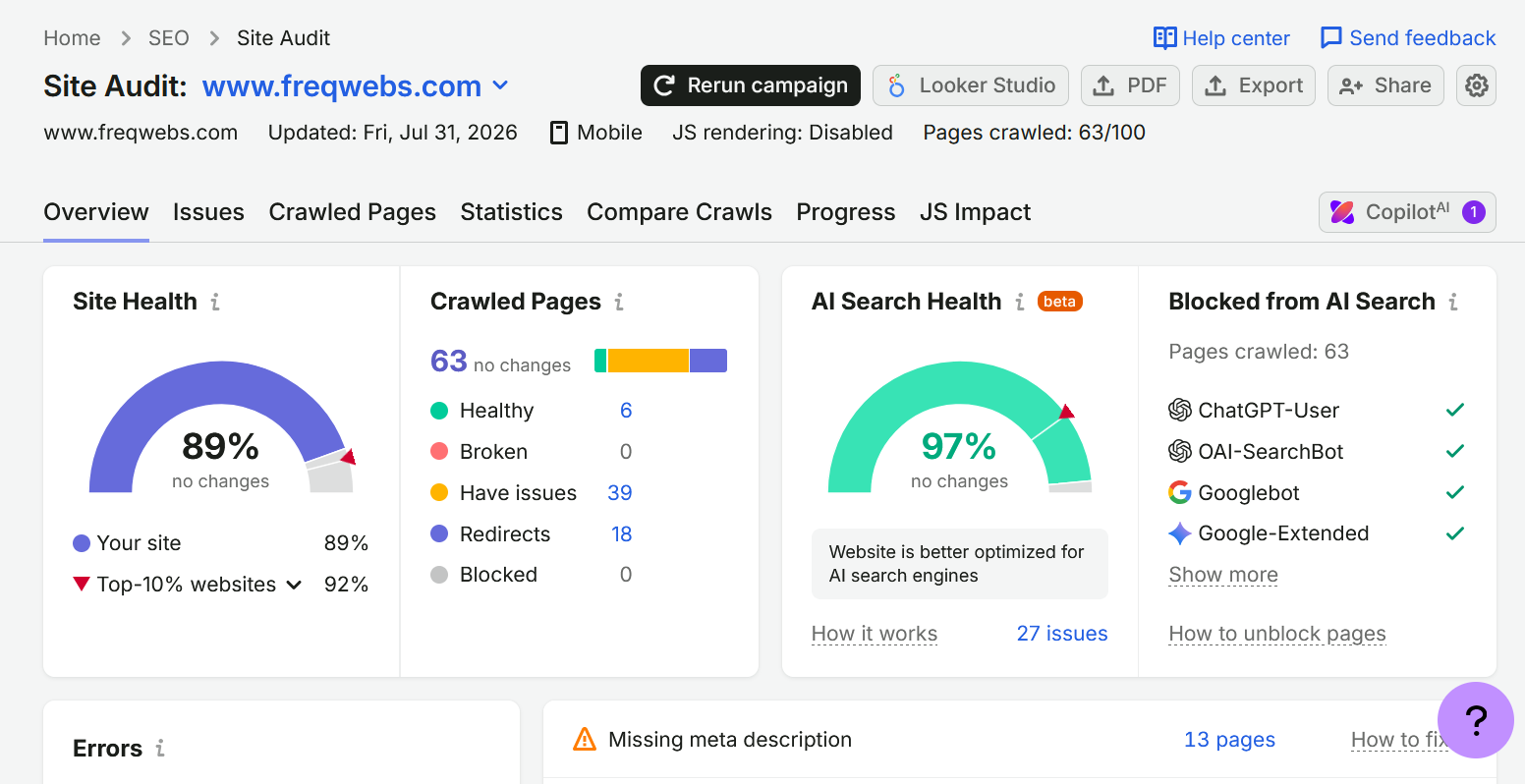
Mangools does not have that kind of Aura site audit tool. This is a real gap if you are seriously thinking of technical SEO stuff.
If you run WordPress sites, SEMrush site audits will catch almost any problems that you would otherwise miss.
Verdict: Semrush is the clear winner. This is a must-have feature, which Mangools doesn't provide.
SERP Analysis
Semrush's SERP Analysis is way ahead of its time; it shows SERP features for almost any keyword: featured snippets, People Also Ask boxes, local packs, and how competitive the landscape is for ranking on Google.
Mangools' SERPChecker gives you a visual treat by showing the top-ranking pages for any keyword, which also includes their domain authority, page authority, backlinks, and social shares, and displays it in a way that gives a visual treat to the eyes.
Both tools do things pretty well. While i found Mangools visual layout is easier for beginners to approach, Semrush gives you more supporting data points.
Verdict: A near tie. Mangools is easier to approach; Semrush has more content.
User Interface & Ease of Use
This is where Mnagools has an edge. The interface, as you can see on the screenshot below, is super clear and built in a way that even an amateur or beginner will learn in a week.
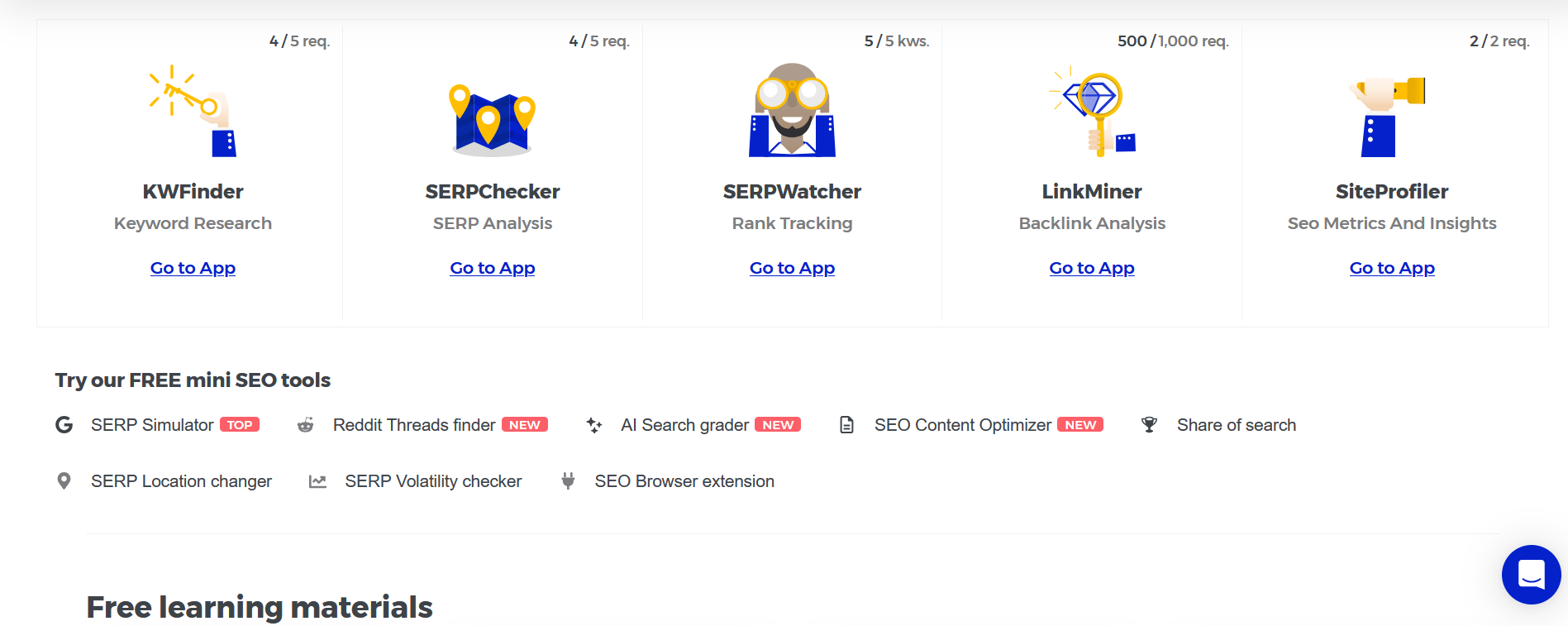
Semrush's interface improved a lot recently, but it still has a dozen tools in their different toolkits: SEO, content marketing, advertising, social media, and more. New users often feel intimidated at first to find things.
If you are starting a blog and want to be hands-on with tools that feel very flexible, go with Mangools.
Verdict: Mangools for beginners, Semrush for users who are tech-savvy and don't mind learning in exchange for more power.
Data Accuracy
Both data pulls numbers through different methodologies, so there will always be different numbers on both, which is normal across many SEO tools if you have used them earlier.
Semrush is generally considered the god when it comes to the accuracy of keyword data, especially for well-established markets like the US and UK.
Mnagools data is also reliable and constant, particularly when it comes to keyword difficulty, though it has less data compared to Semrush.
Verdict: Semrush has an edge when it comes to raw data volume and coverage. Mangools, on the other hand, is accurate for most bloggers and smaller businesses.
Pricing Comparison: Semrush vs Mangools
This is a deciding factor, I guess, so let's break down what you actually pay.
Semrush pricing:
| Plan | Monthly Billing | Annual Billing (per month) | Best For |
|---|---|---|---|
| Pro | $139.95 | $117.33 | Freelancers, small teams |
| Guru | $249.95 | $208.33 | Growing agencies, content teams |
| Business | $499.95 | $416.66 | Large teams, agencies |
SEMrush also offers SEMrush One, a bundled approach that basically combines its SEO toolkit with AI visibility monitoring. Pricing for the bundle plans starts around $199/month. If AI search visibility matters to your strategy, it's worth a look into it. However, the most sold plans are still the classic plans that most bloggers and small businesses opt for.
Mangools pricing:
| Plan | Monthly Billing | Annual Billing (per month) | Best For |
|---|---|---|---|
| Basic | $49 | $29.90 | Bloggers, freelancers, new sites |
| Premium | $69 | $44.90 | Growing businesses, small agencies |
| Agency | $129 | $89.90 | Agencies managing multiple clients |
Mangools also offers permanent free plans with the possibility of getting daily lookups, plus a 10-day trial with elevated limits to test its super features before upgrading to a paying plan.
If you are in the right budget and starting out, Mangools' entry-level pricing surely won't attract you.
Verdict: Mangools is cheaper and better suited for people with tight budgets. Semrush costs more, but it includes far more tools in that price.
Customer Support
Semrush has 24/7 live chat support along with a knowledge base and a dedicated Semrush Academy for learning as well. Higher-tier plans have access to more personalized support.
Mangools offers email and live chats in almost every plan they have. They also have a knowledge base called SEOpedia that explains tedious SEO concepts in plain language, which is quite beneficial for beginners.
Verdict: Semrush has more robust support systems. Mangools support system is smaller but has also been attested to for being responsive to small business users.
Integrations
Sremrush integrated seamlessly with Google Analytics, Google Search Console, Google Business Profile, WordPress, Google Ads, and a ton of other third-party reporting tools, making it easy to plug into your current marketing stack.
Mangools offers Google Search Console and Google Analytics integrations, along with a private API for greater volume of data access and also Looker Studio integration if you are thinking of building custom rank tracking reports.
Verdict: Semrush has wider integration options, which matter a lot if you are managing multiple tools and clients.
Pros & Cons
Semrush
Pros:
- Massive keyword and backlink database
- Full technical site audit tool
- Complete set of a wide range of integrations
- Strong educational resources
Cons:
- Expensive, especially for solo users
- Steep learning curve
- Free plan is very limited
Mangools
Pros:
- Extremely affordable
- Clean and user-friendly interface
- Fast to learn
- Free plan or trial available
- Great for keyword research
Cons:
- No site audit tool
- Smaller keyword and backlink database
- Limited competitor research
- Not built big agencies
Semrush vs Mangools: Side-by-Side Comparison Table
| Category | Winner |
|---|---|
| Keyword Research | Tie (depends on use case) |
| Competitor Research | Semrush |
| Backlink Analysis | Semrush |
| Rank Tracking | Mangools |
| Site Audit | Semrush |
| Ease of Use | Mangools |
| Pricing | Mangools |
| Overall Feature Depth | Semrush |
Who Should Choose Semrush?
Semrush makes sense for this software running businesses and managing multiple clients and looking for SEO growth at fast speed.
If you are a small business owner and have a website that is already generating revenue and you want to scale fast by fixing technical SEO, tracking competitors, and building a backlink strategy, SEMrush's extra cost will pay for itself.
It's also best if you plan to grow content marketing, paid ads, and social media management.
Who Should Choose Mangools?
Mangools makes proper sense if you are starting out a blog, working as a solo creator, or running a small local business because budgets matter more here.
Mangools simplicity makes your life easy as a beginner, as its user-friendly interface makes figuring out seamless. The lower price point is another factor; bloggers use this tool.
It's one of the best tools for agencies as well, which want a fast and visual way to see rankings and backlinks.
Final Verdict
Neither tool is objectively better; that's all i can say,they are the best on different stages of your journey.
If you want all-in-one platform-wide handling of things—technical audits, profound competitor research, and large-scale link building—SEMrush is by far the best tool on the market.
If you are earlier in your journey, testing keyword ideas, tracking, and wanting to keep the cost low, Mangools gives you real value for money.
A common approach for many bloggers is to start with Mangools while building the first 50 articles and then use Semrush to go ahead in your SEO journey.
FAQs: Semrush vs Mangools
Is Mangools good enough for beginners, or should I start with Semrush?
Mangools is generally the best option if you are starting point because of its lower price and simpler interface. You can later upgrade anytime to Semrush once your site grows.
Can I use both Semrush and Mangools together?
Yes. Some marketers use Mangools for quick daily checks and Semrush for deeper monthly audits and competitor research, though this requires two subscriptions.
Does Semrush have a free plan?
Semrush offers a very limited free plan (one project, a small number of tracked keywords) along with a short free trial on paid plans.
Does Mangools have a free plan?
Yes. Mangools offers a permanent free plan with reduced daily limits, plus a 10-day trial with elevated limits to test things out.
Which tool has better rank tracking?
Mangools' SERPWatcher is easier to understand for beginners, while Semrush's Position Tracking gives you granular data, including city-level location tracking and multi-device monitoring.
Which tool is better for technical SEO?
Semrush, undoubtedly. Its Site Audit tool is the best in the market. It crawls your entire site and flags technical issues. Mangools does not offer an audit feature.
Is Semrush worth the higher price for a small blog?
For a small blog with a limited budget, I will not recommend it. Mangools covers the core needs of keyword research and rank tracking at a much lower price. Semrush becomes more valuable when you are managing a larger site or working with clients.
Which tool is easier to learn for someone new to SEO?
Mangools. Its interface is really intuitive, which makes it way easier for someone opening an SEO tool for the first time.
Do prices change often for these tools?
Yes, both companies periodically adjust pricing and introduce some power-packed plans or bundles, so it's worth checking out their official pricing pages before subscribing.
➤ Disclosure: Our content is reader-supported. If you click on certain links, we may make a commission. [Learn More]